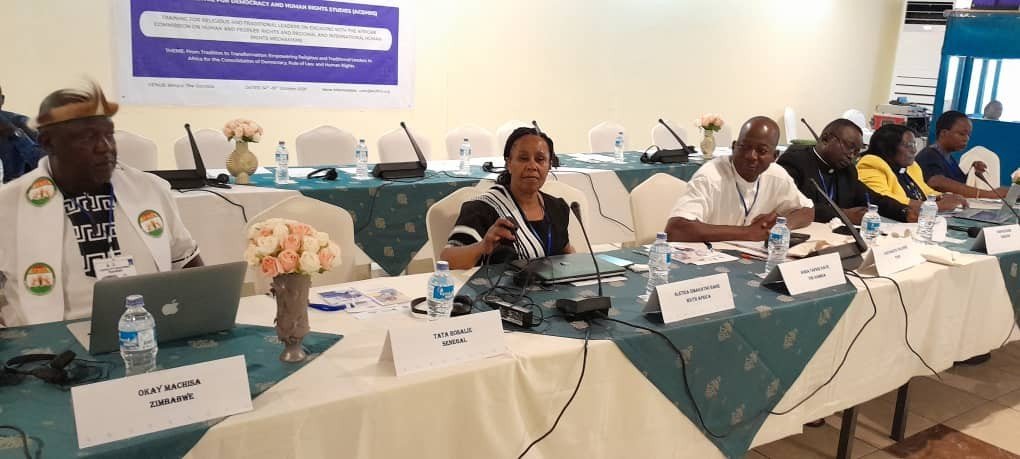
African religious and traditional leaders have been tasked to effectively implement resolutions made at the end of a training on human rights organised by the African Center for Democracy and Human Rights Studies (ACDHRS) and partners.
This task was put to participants following the completion of a three-day seminar for traditional and religious leaders on human rights, held this week at the Kairaba Beach Hotel in Banjul.
The seminar brought together leaders from such countries as Cameroon, Nigeria, South Africa, Guinea Conakry, and Senegal.
The theme was: ‘From Tradition to Transformation: Empowering Religious and Traditional Leaders in Africa for the Consolidation of Democracy, Rule of Law, and Human Rights.’
The forum enhanced participants’ understanding of the challenges posed by conflicts, military coups, SGBV, and human rights violations.
The initiative seeks to foster dialogue, enhance understanding of regional and international rights mechanisms and develop actionable strategies to address current challenges.
Speaking to Senigambia in an interview on the forum’s resolutions, Pastor Dimakatso Alethia Babe, director of Amazing Grace Gauteng Province and Chairperson of Civil Society Unmuted Coalition South Africa, acknowledged that they as religious and traditional leaders have a role to play to ensure they take care of the vulnerable and marginalised communities.
She said the forum’s resolutions capture religious and traditional leaders to form a network where they could hold each other accountable and ensure they implement the resolutions. These, she said, include a continued capacity building for traditional and religious leaders.
She also recommends that politicians undergo regular training on human rights issues to fully understand their roles, as it would help them in upholding human rights in their countries.
“For you to be a leader, you should be relevant and up to date, and capacity building is the only weapon that will actually make sure that you stay current in your leadership,” she stated.
“So, we have asked the ACDHRS to continue training us and to ensure that they hold us accountable because it cannot be money wasted. They need to see how far we have implemented what the Commission asked for.”
As traditional and religious leaders, she said, they belong to a faith-based organizations that are registered as NGOs, and that they should continue to stay relevant within the CSO space and go back and implement the human rights issues they have learned about.
“Because we need to implement, we also need to register for observer status so that we can be writing reports that can assist the Commission to understand if a state like South Africa is actually reporting the true reflection of what is happening in South Africa,” Pastor Babe said.
She promised: “After my return to South Africa, I am going to hold my country accountable, and I have a role: to advocate for and empower the communities about their own human rights, to promote and protect human rights, so that people know about their rights.”