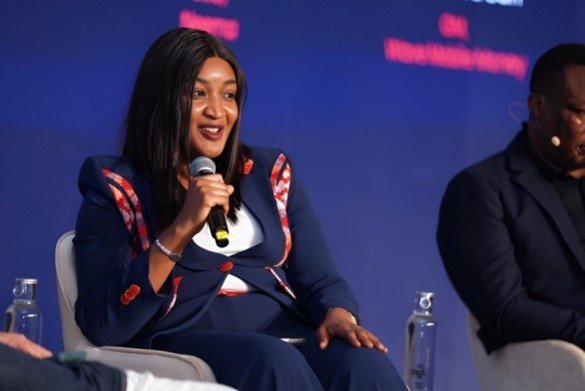
The Managing Director of Wave Gambia Ltd has outlined the company’s long-term vision as it expands operations in The Gambia to become a trusted and impactful partner in the country’s digital and economic transformation.
Speaking in a recent interview with journalists, MD Sainabou Sarr said Wave aims to continue expanding access to affordable financial services while strengthening its presence across communities nationwide.
In the recent past, this growing mobile money network has become a preferred means of financial and most affordable mobile money network in the country. “That means investing in our network, supporting local entrepreneurship, improving user experience, and continuing to innovate responsibly,” she said.
Beyond growth, Sarr said the company’s ambition is about impact. “We want Wave to contribute meaningfully to financial inclusion, economic participation, and the modernization of financial services in the country.” She added that The Gambia is an important market with significant long-term potential.
When asked how Wave plans to increase adoption among informal merchants and small and medium-sized businesses, Sarr said it starts with understanding people’s realities.
“Informal merchants and small businesses need solutions that are practical, affordable, and easy to integrate into their daily operations,” she stated. “Our approach combines accessibility, education, and proximity. Through our growing agent network and field teams, we engage directly with merchants to demonstrate the benefits of digital transactions and help build confidence in their use.”
She said Wave also focuses on simplicity, noting that many entrepreneurs are busy and do not have time for complicated systems. “The easier and more intuitive the service is, the faster adoption tends to happen. Over time, we are seeing growing interest among small businesses in digital finance, which helps them operate more efficiently and securely.”
Wave was among the institutions that participated in the recently concluded GCCI Trade Fair. Asked about the role of the fair in Wave’s engagement strategy, Sarr said it remains one of the country’s most important business and consumer platforms and a strategic opportunity for the company.
“It allows us to engage directly with the public, with entrepreneurs, with merchants, and with the broader business community in a very interactive environment. Beyond visibility, it is also an opportunity to listen, educate, and strengthen relationships,” she stated.
She said this year’s participation reflects Wave’s commitment to being close to Gambians and actively contributing to conversations around innovation, entrepreneurship, and digital transformation. The Trade Fair, she added, also allows the company to showcase how digital financial services can support businesses and simplify everyday transactions in a rapidly evolving economy.
On reliability, security, and compliance, Sarr said these are critical pillars of Wave’s operations.
“We continuously invest in technology, operational processes, and internal controls to ensure our services remain stable, secure, and trustworthy for users across the country. We also work closely with regulatory authorities and relevant institutions to ensure that our operations align with national standards and requirements. Compliance is not a one-time obligation. It is an ongoing responsibility.”
She added that trust is built through consistency: “Users need to feel that the service works, that their money is secure, and that support is available when needed. That is why customer experience and operational excellence remain key priorities for us.”
On trends in digital payment usage, Sarr said Wave sees growing openness towards digital financial services across different segments of the population.
She explained: “We are seeing increasing awareness around the convenience and practicality of digital payments, particularly among young people, entrepreneurs, and small businesses. More users are recognizing the value of fast, accessible and secure financial tools in their daily lives. We are also observing a gradual cultural shift. Digital payments are increasingly becoming part of everyday economic activity rather than something perceived as purely optional or secondary.”
She said this evolution is positive because it reflects a broader movement towards financial modernisation and inclusion in The Gambia.