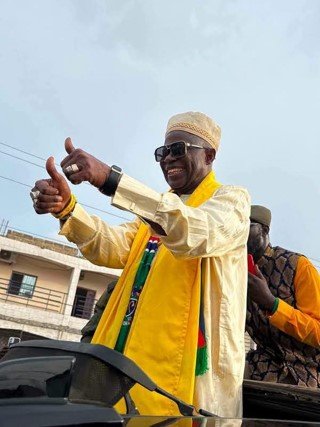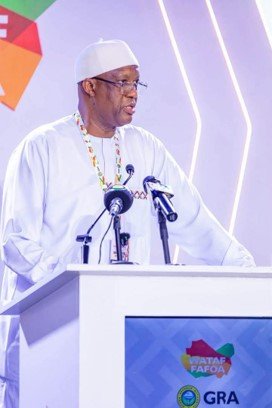
Few appointments in The Gambia’s democratic history have generated as much legal intrigue and national debate as President Adama Barrow’s decision to appoint renowned lawyer Edrissa (Edi) M.O. Faal as Chief Justice.
What should have been a routine transition at the apex of the judiciary has instead evolved into a constitutional showdown, pitting the Executive against the country’s leading professional body of lawyers. At stake is far more than a single appointment. The outcome could redefine the limits of presidential authority, clarify the Constitution’s requirements for the nation’s highest judicial office, and shape the future of judicial appointments for generations.
A Celebrated Lawyer, An Unprecedented Controversy
Few question Edi Faal’s credentials as a lawyer. A respected international legal practitioner with decades of experience in the United States, he has built a career that commands admiration both at home and abroad.
To many, his appointment symbolised confidence in the Gambian diaspora and recognition that the country should harness the expertise of its accomplished professionals overseas.
Yet almost immediately after the announcement, attention shifted away from Faal’s impressive résumé to a more fundamental question:
Was the appointment constitutional?
That question has now become the center piece of one of the most consequential constitutional disputes since the democratic transition of 2017.
The Bar Association Draws a Constitutional Line
The Gambia Bar Association (GBA), after deliberations among its membership, took the unusual step of publicly opposing the appointment.
Its argument was carefully framed. The Association made clear that it was not questioning Edi Faal’s integrity, competence or legal ability. Instead, it contended that Section 139 of the 1997 Constitution sets specific qualifications for appointment as Chief Justice and that those qualifications had not been satisfied.
Believing the issue to be one of constitutional fidelity rather than personal preference, the Bar Association escalated the matter to the Supreme Court, asking the country’s highest judicial authority to determine whether the appointment is legally valid.
It is a remarkable moment. Rarely does the organised legal profession challenge the appointment of the individual selected to become its own judicial leader.
A Question Hidden in a Few Words
Constitutions often appear straightforward until every word begins to matter.
The entire controversy turns on the interpretation of Section 139.
Does the Constitution require previous judicial service in a superior court before someone may become Chief Justice?
Or can decades of distinguished legal practice in superior courts within another common-law jurisdiction satisfy the constitutional standard?
Legal scholars have found themselves divided. Some favour a strict reading of the constitutional text, arguing that judicial qualifications exist to preserve institutional consistency and safeguard the judiciary’s independence.
Others advocate a purposive interpretation, contending that constitutions should evolve to reflect modern realities and should not unnecessarily exclude highly qualified Gambians serving internationally.
The Supreme Court must now decide which interpretation prevails.
Why This Case Matters Beyond One Man
Although Edi Faal’s name dominates headlines, the litigation reaches much deeper than one appointment.
The Court’s ruling will answer questions that could influence every future President and every future judicial appointment.
Among them:
How far does presidential discretion extend when appointing senior judges?
Should constitutional qualifications be interpreted narrowly or purposively?
What balance should exist between attracting diaspora expertise and adhering to constitutional text?
How should ambiguities in the Constitution be resolved?
The answers will become part of Gambian constitutional jurisprudence, guiding governments long after the present controversy has faded.
A Judiciary Under the Spotlight
The irony has not escaped observers.
The institution entrusted with interpreting the Constitution is now being asked to decide whether the appointment of its own incoming head complies with that very Constitution.
Whatever decision emerges, the Court will face intense public scrutiny. It must demonstrate not only legal rigour but also complete institutional independence.
Public confidence in the judiciary depends as much on the transparency and credibility of the process as on the outcome itself.
Democracy’s Quiet Strength
While emotions surrounding the issue have been strong, the unfolding events also reveal something encouraging about The Gambia’s democratic evolution.
A professional association has exercised its right to challenge executive action.
The Executive has defended its decision.
The dispute has been placed before the courts rather than settled through political confrontation.
This is precisely how constitutional democracies are designed to function.
The case illustrates that no public office—even that of Chief Justice—is beyond constitutional scrutiny.
The Verdict That Will Echo
When the Supreme Court finally delivers its judgment, it will do more than determine whether Edi Faal lawfully assumes the nation’s highest judicial office.
It will define how constitutional qualifications are interpreted. It will clarify the scope of presidential appointment powers. It will reinforce—or recalibrate—the delicate balance between the Executive and the Judiciary.
Most importantly, it will send a message about the enduring supremacy of the Constitution.
In constitutional democracies, individuals come and go. Governments change. Chief Justices retire and are replaced. But the Constitution endures.
The significance of this case lies not in the identity of the man whose appointment has been challenged, but in the principles that will emerge from the Court’s interpretation. Those principles may shape The Gambia’s legal landscape long after today’s headlines have disappeared, making this one of the defining constitutional moments of the country’s modern democratic journey.