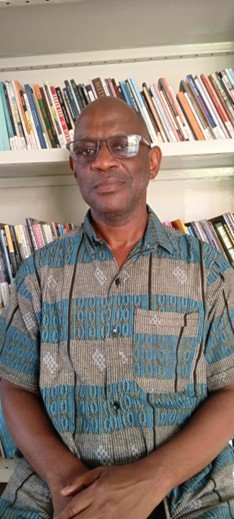
As The Gambia seeks to upscale its tourism growth beyond sun and beach, the Director General of the National Centre for Arts and Culture (NCAC), Hassoum Ceesay, is at the forefront of projecting the country’s remarkable cultural heritage sites to give them their true meaning and significance to Gambians and to humanity.
In an exclusive interview at the NCAC headquarters at Pipeline, DG Ceesay spoke passionately about two of The Gambia’s UNESCO World Heritage Sites — Kunta Kinteh Island and the Wassu Stone Circles — detailing their historical, social, political and economic productivity.
Kunta Kinteh Island, a place of horror and terror
Asked why Kunta Kinteh Island stands out among The Gambia’s heritage assets, DG Ceesay began with its origin, saying: “Well, the old name is James Island. It was first inhabited by the Portuguese in the 1450s. It became an important player in the Transatlantic Slave Trade as a departure point for slaves and slave ancestors,” he said.
The island, located in the middle of the River Gambia, was renamed from James Island to Kunta Kinteh Island in 2011 by former President Yahya Jammeh. The name change, Mr Ceesay explained, was to honour the hero of Alex Haley’s iconic book “Roots”, published about 50 years ago, which details the life of a young Gambian captured in Juffureh, opposite the island, in 1767.
Drawing a comparative significance, the historian noted: “Now, Kunta Kinteh Island is what Goree is to Senegal or Elmina Castle is to Ghana or Bonthe Island is to Sierra Leone. It was like a crime scene in the sense that the hundreds of our ancestors who were forcibly transported to the new world in slave circles departed from this Kunta Kinteh Island.”
DG Ceesay described the island’s geography as part of its cruelty. “It is right in the middle of the River Gambia. So, it was almost a place where you cannot escape from. It was a place of horror and terror,” he emphasised.
He said the dungeons still attest to that horror. According to him, slavers used the island as a barracoon — a holding place for captives.
“To use the word of the historians, where you gather the captives until there was enough to fill the ship. Because, remember, the slave ships were insured to carry a certain amount of human beings,” Ceesay explained. “So as long as that cargo was not met, the slaves would not depart.”
Unlike modern transport that departs on schedule whether full or not, he said, the slave dealers in their “economic wisdom” would wait until they had enough human cargo before sailing through the Middle Passage to the New World.
Kunta Kinteh Island has been a UNESCO World Heritage Site since 2003, and Mr Ceesay disclosed that government has good plans to enhance its integrity and authenticity to make it more appealing and educational.
Wassu Stone Circles, an archaeological enigma and a wonder
Talking about the Wassu Stone Circles, another key tourism site, Hassoum Ceesay was equally illuminating. He said: “Well, the Wassu Stone Circles are also a UNESCO World Heritage Site. These are megaliths, they are stones, standing stones, that should be a testimony to the advanced level of technology of our ancestors.”
He stressed that to write the true history of Africa, we must resort to archaeology, and the stone circles are a perfect example. He revealed that The Gambia has inventoried close to 200 stone circle sites.
“They are widespread,” he explained. “So, it’s more of a landscape. When you talk about the stone circles, you are referring to a landscape, not just one or two sites, or like an incidental monument.”
Ceesay says archaeological surveys show that in the middle of the circles is a burial ground. “I mean, human remains have been found, grave goods have been found. So, the first interpretation of that is that these were burial sites… those who built them had the audacity and the knowledge to bury human beings with their worldly possessions,” he pointed out.
But he cautioned that research is still ongoing. “Of course, the research on the stone circles is still a work in progress. Maybe as we speak, we only know 5% of the significance of the sites,” he said. He also pointed to emerging scholarship looking at their astronomical alignment and even therapeutic importance, noting claims that “in the evening hours and in the early hours of the day, they ooze out a rare type of heat that has healing powers”.
“So, you can see that they remain an enigma,” he buttressed. “They are like an archaeological enigma.”
What is absolutely clear, he stressed, is the high degree of technology involved. Near every stone circle site, he explained, there is a quarry where stones were carved out “in splendour and in very, very good proportions” and then transported 100, 200, 300 metres down the hill to the site, he narrated, in concurrence: “So really, they are a wonder – the stone circles are a wonder.”
DG Ceesay also believes preserving these sites is not just about tourism revenue, but about reclaiming Gambian identity and telling the African story from an African perspective.