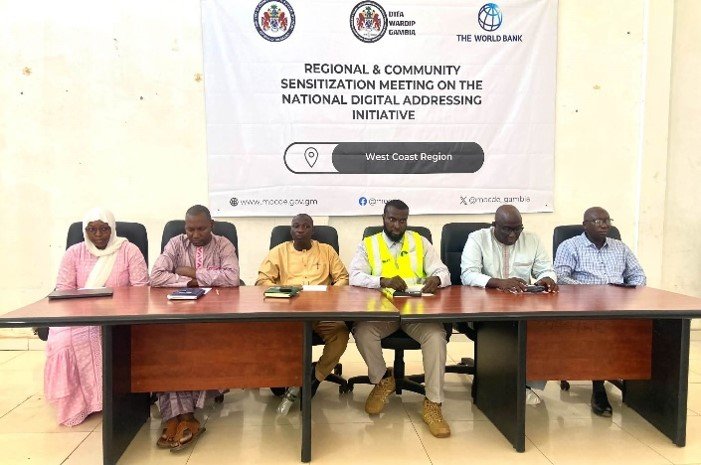
The Ministry of Communications and Digital Economy has intensified efforts to promote the National Digital Addressing Initiative through a two-day Regional Community Sensitisation Forum aimed at strengthening governance, improving public service delivery, and accelerating the adoption of digital addressing across the West Coast Region.
The forum, which began at the Brikama Area Council and continued at the Governor’s Office, brought together Seyfolu, Alkalolu, community elders, councillors, council staff, and other stakeholders to enhance their understanding of the initiative and equip them to raise awareness within their communities.
Officials emphasised that the National Digital Addressing Initiative is more than the assignment of addresses to properties. It seeks to establish a reliable national digital addressing database that will support economic growth, financial inclusion, national security, and efficient public administration.
Speaking at the opening ceremony, Brikama Area Council Chairman, Yankuba Darboe, described digital addressing as an important tool for strengthening local governance and improving service delivery.
According to the Chairman, the initiative will assist the Council in improving property identification and records management, enhancing property rate administration and revenue mobilisation, supporting effective fiscal planning, and facilitating the delivery of essential services.
He called on councillors, traditional leaders, youth representatives, and residents to actively support the initiative through community participation and public awareness campaigns. Mayor Darboe also urged communities to safeguard digital addressing infrastructure, particularly address poles and related installations, stressing that they are valuable public assets established for the benefit of all citizens.
The WARDIP Project’s Environmental Safeguards Officer, Mrs Ndey Sirreh Hydra, highlighted the significance of digital addressing in promoting economic development and enhancing public safety.
She noted that a reliable addressing system would make it easier for businesses to reach customers, enable financial institutions to accurately identify and locate clients, and improve the delivery of essential services.
Mrs. Hydra further underscored the initiative’s importance in emergency response, stating that the ability to accurately locate individuals during medical emergencies, fires, and security incidents could save valuable time and lives.
The Ministry’s Deputy Permanent Secretaries for Technical Services and for Administration and Finance described the forum as an important platform for stakeholder engagement, practical demonstrations, and constructive dialogue. They emphasised the need to address public concerns, strengthen understanding of the initiative, and build collective commitment towards its sustainable implementation.
According to him, the Gambia continues to advance its digital transformation agenda, officials believe that active community participation, strong stakeholder collaboration, and the protection of digital addressing infrastructure will be critical to achieving the full benefits of the initiative.
He maintained that digital addressing is not only about locating homes and properties but also about connecting citizens to essential services, expanding business opportunities, and promoting inclusive national development. He called on all citizens to embrace the initiative in support of a more connected, inclusive, and accessible Gambia where every community is accounted for and no location is left behind.