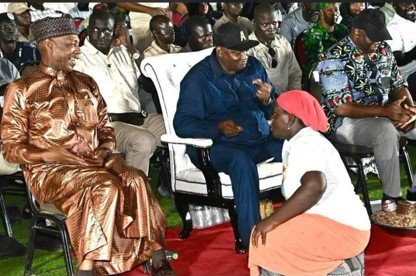
President Adama Barrow is leading the presidential race in six of The Gambia’s eight Local Government Areas (LGAs), while opposition leader Ousainou Darboe maintains an advantage in Brikama, according to the latest pre-election opinion poll released by the Centre for Policy, Research and Strategic Studies (CepRass).
The survey, conducted between October 17 and November 1, interviewed 1,180 registered voters across all eight LGAs and 53 constituencies ahead of the December 5 presidential election.
According to the findings, Barrow’s NPP-led alliance commands 37.9 per cent of national voting intention, placing it ahead of Darboe’s Gambia First Coalition, which stands at 24.2 per cent. Coalition 2026, led by Talib Ahmed Bensouda, follows with 11.3 per cent support.
The poll shows Barrow recording his strongest support in Kuntaur, where he attracts 79.7 per cent of voter preference. He also leads decisively in Basse with 78 per cent, Janjanbureh with 61 per cent and Mansa Konko with 46.2 per cent.
In Kerewan, Barrow holds a narrow lead with 37.6 per cent compared to Darboe’s 36.7 per cent. He is also ahead in Kanifing, securing 31.7 per cent support against Darboe’s 19.5 per cent and Bensouda’s 12.9 per cent.
Banjul also favours the incumbent, with Barrow polling 26.9 per cent, followed by Darboe on 18.2 per cent and Bensouda on 16.2 per cent.
Darboe’s strongest performance comes in Brikama, the country’s most populous LGA, where his coalition leads with 29.6 per cent support. Barrow follows closely with 27.8 per cent, while Bensouda records 11.5 per cent.
Beyond current voting intentions, the survey indicates that many voters believe Barrow is on course for victory. Forty-eight per cent of respondents said they expect the incumbent to win the election, compared to 23 per cent who believe Darboe will emerge victorious and 8 per cent who predict a win for Bensouda.
The poll also highlights the issues shaping voter choices. The cost of living was identified as the most important election issue by 43 per cent of respondents, far ahead of security at 18 per cent and food prices at 14 per cent.
Economic concerns featured prominently throughout the findings. Eighty per cent of respondents described current economic conditions as either fairly bad or very bad, while 76 per cent said the economy had deteriorated over the past year.
Electricity was also cited as a significant concern, with 66 per cent of respondents saying the power situation would influence how they vote in December.
Despite the clear lead enjoyed by Barrow, the poll suggests a sizeable section of the electorate remains open to persuasion. Twelve per cent of voters said they were undecided, while a further 4 per cent declined to reveal their preferred candidate.
CepRass said the survey carries a nominal margin of error of approximately three percentage points at a 95 per cent confidence level. The organisation cautioned that the results reflect voter sentiment during the survey period and should not be interpreted as a prediction of the final election outcome.