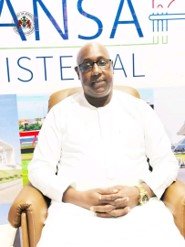
The Minister of Agriculture, Livestock and Food Security, Hon. Demba Sabally, says The Gambia is targeting an annual rice production of 200,000 metric tonnes by 2030, outlining ongoing government interventions in land development, seed production, mechanisation and processing to achieve the target.
The Minister made these remarks on Friday during the final 2026 edition of the Mansa Kunda Town Hall Meeting, held at the Sir Dawda Kairaba Jawara International Conference Centre, where he responded to questions on the government’s plans to achieve rice self-sufficiency.
Sabally said the country needs 20,000 hectares of well-developed agricultural land to sustain rice production throughout the year, stressing that access to irrigated farmland is essential to reducing dependence on rainfall.
“This country needs 20,000 hectares of well-developed land. Once 20,000 hectares are developed, this country should be able to produce throughout the year,” he said.
He disclosed that the Regional Rice Value Chain Project is developing land at nearly eight sites across the country, which will be equipped with solar-powered irrigation systems.
The ROOTS Project, he added, is also developing nearly eight additional sites and reclaiming abandoned farmland for rice cultivation.
On seed production, the Minister said local production has increased from less than 400 metric tonnes in 2022 to more than 1,000 metric tonnes this year.
He said the country’s target is to produce 2,000 metric tonnes of high-quality climate-smart rice seeds by next year.
“The expectation by next year is that we should be meeting our target, which is to produce 2,000 metric tonnes of high-quality climate-smart rice seeds,” he said.
Sabally further disclosed that a seed complex under construction in Central River Region South is expected to be completed by 2028 to strengthen local seed production.
He said improved seeds have contributed to higher yields, with some farmers now producing up to 10 tonnes per hectare, compared to approximately one tonne previously, while other farmers record between four and six tonnes per hectare.
The Minister also identified mechanisation as another key intervention, citing the introduction of combine harvesters, automated transplanters and a tractor financing scheme.
Under the scheme, the government covers 25 per cent of the tractor cost, while farmers contribute another 25 per cent. The remaining amount is paid in instalments over four years under a government guarantee.
Sabally said the initiative is intended to make tractor ownership more accessible to farmers and reduce dependence on manual labour.
He also highlighted the distribution of herbicides through agricultural projects to reduce the labour involved in weeding, particularly for women and smallholder farmers.
On processing, he disclosed that more than 100 rice mills were supplied during the 2025/2026 period to improve access to milling facilities.
He added that drying floors and seed stores are also being provided to reduce post-harvest losses and improve the storage and quality of locally produced rice.
“These and some other steps are the surest ways to ensure that by 2030, this country will produce 200,000 metric tonnes,” he said.
Sabally acknowledged that current national rice production stands at approximately 47,000 metric tonnes, representing about 24 to 25 per cent of the country’s requirement. He maintained that ongoing interventions would help close the production gap.
Responding to a question on youth participation in agriculture, the Minister said the D1.1 billion Matching Grant Scheme supports businesses across several agricultural value chains, including rice, cashew and poultry.
He also cited a pilot initiative involving about 20 graduates from Gambia College and the Gambia Songhai Initiative, who were recruited last year and supported to venture into commercial farming.
According to Sabally, the Ministry partnered with Maru Farms to provide each participant with one hectare of land, seeds, ploughing services and mentorship throughout the farming season.
He said all 20 participants have remained in Central River Region South and are currently engaged in farming.
The Minister further disclosed that the International Organization for Migration (IOM) has approached the Ministry to sponsor 100 young migrant returnees for a one-year agricultural training and coaching programme.
He said the initiative, alongside the Matching Grant Scheme and increased mechanisation, is expected to encourage more young people to take up agriculture.
Sabally also acknowledged the contributions of development partners, including the ROOTS Project and the Islamic Development Bank, to the country’s agricultural development efforts.
He said the government’s interventions are aimed at transitioning the sector from predominantly smallholder, rain-fed farming to modern, mechanised