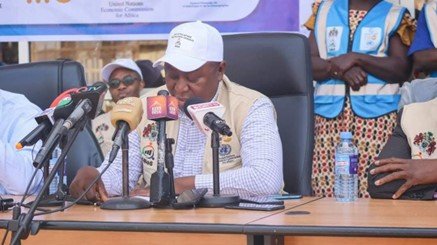
The Gambia Bureau of Statistics (GBoS) has raised concern over the country’s labour market structure, calling for urgent policy action to expand formal employment opportunities after new data revealed that informality continues to dominate work across the country.
The latest report, The Gambia Labour Market: Progress and Trends (2022–2026), shows that 85.8 per cent of employed persons were engaged in informal work in the first quarter of 2026 meaning fewer than two in ten workers are in secure, regulated employment with social protection benefits.
According to the findings, the informal economy remains deeply entrenched across major sectors of the economy. Informality is almost universal in construction (98.1 per cent) and agriculture (97.7 per cent), while it also remains extremely high in accommodation and food services (93.6 per cent) and wholesale and retail trade (91.5 per cent). Overall, the informal sector accounts for 75.9 per cent of total employment, compared to just 22.3 per cent in the formal sector.
The report highlights stark inequalities in the labour market, with women and rural populations bearing the greatest burden of informal employment. Women account for 88.7 per cent informality compared to 83.6 per cent among men, while rural workers stand at 91.2 per cent, significantly higher than urban workers at 83.1 per cent.
Employment status also plays a major role in determining job security. Contributing family workers and dependent contractors are almost entirely absorbed in informal arrangements, while even employees often assumed to be in more stable jobs record a high informality rate of 63.5 per cent.
Education emerges as a critical factor in escaping informal work. The report shows informality exceeding 92 per cent among workers with low levels of education, but dropping sharply to 37 per cent among those with higher education, underscoring the strong link between skills, qualifications, and access to formal employment.
Geographical disparities further expose the uneven distribution of opportunity across the country. The highest informality rate was recorded in Basse at 93.2 per cent, while Banjul recorded the lowest at 78.4 per cent – still indicating that nearly eight out of ten workers in the capital operate outside the formal system.
Beyond employment status, the survey also points to imbalances in working hours. While the standard reported workweek stands at 44 hours, the average actual hours worked is 36.6, leaving a gap of 7.4 hours that signals widespread underemployment.
At the same time, nearly 40 per cent of workers report working more than 49 hours per week, revealing a dual challenge of underemployment on one hand and excessive labour demands on the other – an imbalance the report says undermines productivity and wellbeing.
In response, GBoS has urged government and stakeholders to prioritise the expansion of formal job opportunities and strengthen labour market systems. The bureau is also calling for improved social protection coverage for vulnerable workers, alongside increased investment in education and skills development.
Targeted interventions in rural areas and high-informality sectors, the report notes, will be essential to addressing structural inequalities and improving job quality nationwide.
GBoS further warned that without decisive reforms, informality will continue to limit tax revenue, weaken worker protections, and slow national productivity growth.
The report was circulated through a link shared by the Ministry of Information, Media and Broadcasting Services following public debate over earlier government claims of more than 160,000 jobs created.