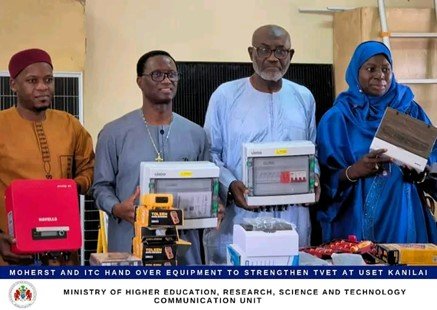
The Ministry of Higher Education, Research, Science and Technology (MoHERST), in partnership with the International Trade Centre (ITC) through the United Nations (UN) Peacebuilding Fund, has handed over electrical appliances valued at Two Million Ninety-Five Thousand Five Hundred Dalasi (GMD 2,095,500) to the University of Applied Science, Engineering and Technology (USET) Kanilai Campus.
The appliances handed over on 24 April 2026 included electrical solar installation equipment and refrigeration and air conditioning tools. Officials said the initiative is aimed at strengthening skills development and technical and vocational education and training (TVET) in The Gambia, as well as improving the learning environment.
The support targets priority programme areas such as Electrical and Solar Installation, Plumbing and Pipefitting, and Hairdressing. It forms part of ongoing collaboration with ITC to enhance the quality and relevance of TVET delivery in the country.
Speaking at the event, the Minister of Higher Education, Research, Science and Technology, Professor Pierre Gomez, said the initiative is intended to reduce regional disparities and support vocational training, while creating employment opportunities for young people.
“This initiative will also contribute to the standardisation of training in line with industry requirements, while promoting employability and entrepreneurship. Graduates will be equipped not only for wage employment but also to establish their own enterprises in areas such as solar installation, electrical services, and refrigeration and maintenance works.
The Vice-Chancellor of USET, Engr. Prof. Nazmat T. Surajudeen-Bakinde, has commended the International Trade Centre and the Ministry of Higher Education, Research, Science and Technology for the donation of equipment to the USET Kanilai Skills Training Centre, describing the support as a major boost to technical and vocational education in The Gambia.
Speaking at the official handing over ceremony, the Vice-Chancellor said the intervention represents a strategic investment in the future of students and the advancement of skills development, noting that the equipment will strengthen practical training, enhance institutional capacity, and better prepare students with industry-relevant competencies.
She praised ITC for the generous and timely support, emphasizing that the donation goes beyond the provision of equipment and reflects a commitment to empowering young people through quality technical and vocational education.
Prof. Surajudeen-Bakinde also commended MoHERST for its continued leadership and commitment to strengthening higher education and skills development, noting that the ministry’s support continues to create opportunities for youth empowerment and institutional growth.
She assured partners that USET will make effective and responsible use of the equipment, with a strong commitment to maintenance and sustainability to ensure long-term benefits for current and future learners.
Reaffirming USET’s commitment to excellence in applied science and technology education, the Vice-Chancellor expressed gratitude to both ITC and MoHERST for their invaluable support in advancing Technical and Vocational Education and Training (TVET) in the country.
ITC Country Representative Yusupha Keita underscored the broader impact of the intervention, linking skills development to peace building and economic inclusion.
“These are not just assets they are investments in dignity, productivity, and long-term resilience,” he stated.
He also said ITC’s interventions in The Gambia had contributed over 5,000 jobs, while strengthening TVET centres and supporting youth and women entrepreneurs.
“When communities have access to opportunities and livelihoods, peace becomes stronger and more sustainable,” he added.
Centre Manager Momodou Barry welcomed the initiative, describing it as transformative for the Kanilai Skill Training Centre.
“These modern tools will greatly enhance our capacity to deliver effective hands-on training,” he said.
He emphasised that students will now be better equipped with industry-relevant skills in solar installation and refrigeration.
“Our students are now in a stronger position to meet industry standards and contribute meaningfully to national development,” Barry noted.
The intervention is expected to bring wide-ranging benefits to Kanilai and the Foni regions, including increased access to practical skills for young people in rural areas, job creation and self-employment opportunities, especially in solar energy and technical trades. It would also support women’s livelihoods, including garden projects and market access while improving training quality, with modern tools and competency-based learning, promotion of renewable energy, contributing to sustainable development.
Additionally, the provision of solar-powered boreholes and support to women’s gardens will enhance food security and income generation for families in the region.
The event marks a significant step towards bridging the gap between education and employment in rural Gambia. By bringing modern training tools closer to communities, the initiative is expected to inspire more young people to pursue technical education and build sustainable livelihoods.
As Minister Pierre Gomez reaffirmed his ministry’s commitment to strengthening partnerships, he said his sector is interested in tools not money.