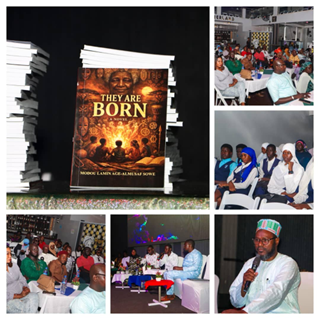
Modou Lamin ‘Age-Almusaf’ Sowe, the leading contemporary young Gambian writer and scholar, has launched his latest book, a novel that goes by the title ‘They Are Born’.
The launching of this mega work of literature took place on the sidelines of Saturday’s National Conference on Youth Development and Nation-Building through Literature, a national convergence initiated by him through his foundation to revive a declining reading culture and literacy.
As a Gambian author and one of the most respected emerging literary voices in West Africa, Modou Lamin Sowe’s writing spans across all three genres of literature – prose, poetry and drama. His previous books include Don’t Judge the Book by Its Cover, The Throne of the Ghost, The Memories of Reflection, and AfriKa, Not AfriCa. He has also been featured in an anthology of writers across the continent, titled Twaweza.
The award-winning author’s latest novel furthers his legacy as an author who hopes to establish literature as a tool for social reflection, education and cultural continuity.
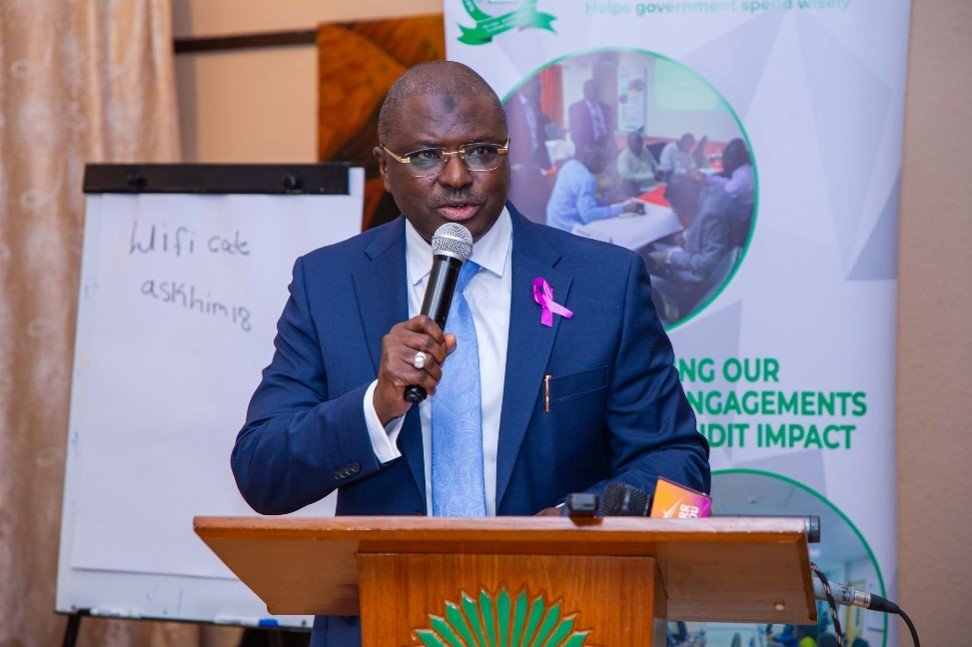
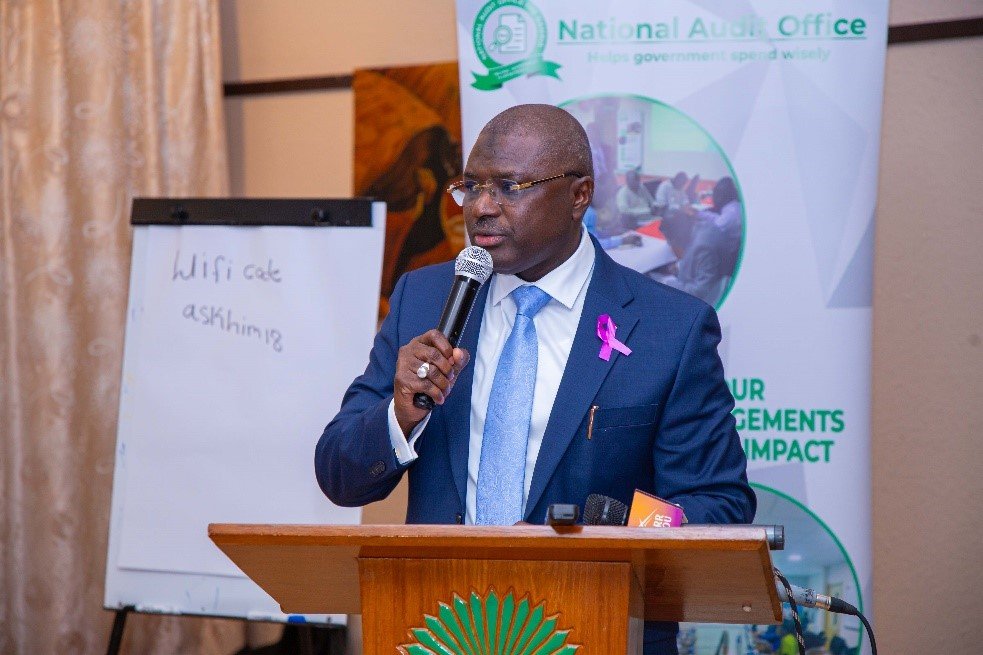
The book launch was attended by top government and local government officials, dignitaries, scholars, thought leaders and students. Other members of the wider public also graced the occasion.
In his remarks during the event, Saikou Sanyang, the principal education officer, who deputised the Minister of Basic and Secondary Education (Habibatou Drammeh), stated that more than the mere unveiling of a publication, the book launch opened new doors for learners, teachers and communities.
He describes the novel as a reflection of the transformative power of education and youth empowerment.
“Books carry the wisdom of generations, the dreams of authors and the aspirations of nations,” he says. “This particular work being launched today will undoubtedly contribute to the growth of knowledge, the promotion of literacy, and the empowerment of readers across our country and beyond.”
As the book was being celebrated, with the conversations it inspires, Sanyang urges a reaffirmation of a collective commitment to championing education and literature and pillars of national progress.
Mayor Rohey Malick Lowe, Mayor of Banjul; Michael Hamady Secka, author and retired curriculum development official at MoBSE; Hassoum Ceesay, historian and director general of National Centre for Arts and Culture, and others spoke in colourful words about the book.
Meanwhile, in his review of the book, Cherno Omar Barry, author, Professor of comparative literature and current president of The Writers’ Association of The Gambia, notes that Modou Lamin doesn’t just tell a story in his novel but rather constructs a warning, “a slow-burning, deeply reflective narrative that mirrors the realities of our societies today”.
“At its heart lies Ndia, a village that could be anywhere in Africa – and, if we are honest, everywhere,” he remarked. “The novel opens not with spectacle, but with stillness – with dust, millet, and memory. And in that stillness stands Fercilu, the last custodian of Hamani, a language fading under the weight of what we often call ‘progress’. This is where the author is most deliberate. He forces us to understand that language is not merely a tool of communication. It is an archive. A living archive. And when that archive collapses, it does not do so loudly – it disappears quietly, politely, almost respectfully… until one day, there is nothing left.”
Barry explored the various perspectives of various giants of African literature (Chinua Achebe, Ngugi wa Thiongo, Leopold Sedar Senghor, Wole Soyinka) on the same subject of language.
He explains further: “What makes this novel devastating in its honesty is the way it shows us the community’s own complicity.
“The novel tells us that Hamani was ‘the same ancient language teachers discouraged. The same language parents apologised for when visitors came’. Children were punished for speaking it in class. Parents instructed their children to ‘speak properly. Properly meant elsewhere. Hamani meant here. Here had stopped being enough’ (chapter one).
“This is not a distant colonial tragedy. It is a domestic one. It is happening in our countries today – when parents rush their children to learn foreign languages before they can string together a sentence in their own; when national languages are absent from boardrooms, courtrooms, and classrooms; when we quietly signal to the next generation that who they are is not sufficient for the world they must enter.”
Following a succinct and deep analysis of the book, especially from comparative lens with the works of the African Literature giants and pioneers, Barry concluded: “They Are Born is not just about children. It is about responsibility. Each generation is born into a choice: to inherit blindly, or to inherit consciously. This novel urges us – firmly, unapologetically – to choose the latter.
“The forest in Ndia does not forget. The ancestors in Ndia do not forgive erasure. And the children of Ndia – scattered across the earth, as the opening poem reminds us, from Nigeria to Paris, from New York to Germany – are still being born.
The question is: what will we leave them to speak? Because as Fercilu tells us in the forest, speaking to the very children the world wishes to take from their village: “You carry what cannot be written. You carry what cannot be stolen. (They Are Born, Chapter Four). That is the inheritance we must protect.”
Meanwhile, the author gave a brief vote of thanks, extending gratitude to his family, partners and sponsors, education and literature stakeholders, and his readers.