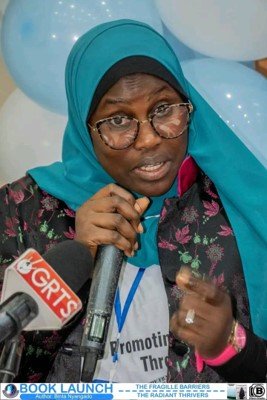
Binta Nyagado is a young teacher at St. John’s School of the Deaf, but a resolve to contribute in changing the mental health situation many young people in her country face has turned her from a mere classroom teacher to a someone who teaches healing from within. She campaigns against depression and anxiety.
However, she is not providing tablets. She is not providing endless therapies, although they are paramount. She provides words and their magic; she presents books to inspire a kind of help that comes from within, premised on the power of words and their ability to trigger much-needed reflections.
In March 2026, Binta penned down and published two personal development books. The books carry the titles ‘The Radiant Thrivers: Dismantling Toxic Dynamics’ and ‘Fragile Barriers’ respectively.
In an exclusive interview with this reporter, Binta described the books as “ground-breaking personal transformation guides embodying assistive therapeutic resources in the areas of self-actualization, emotional regulation development, mindfulness skills, practical gratitude exercises and resilience”.
she underscored that her aim is to uproot the ills of society, heal and restore positive emotional well-being by instilling a sense of empowerment in ourselves and others for personal and social advancement.
She added: “They are small powerful books capable of transforming lives and improving psychological conditions like anxiety and depression while promoting emotional education as a tool. The concept of the books involves actively influencing one’s life in a number of domains – cognitive, relational and environmental – in order to foster personal development and meaning. It combines self-reflection with the transformation of negative experiences into motivation for progress.
“Its narrations are done in contemporary literature and modern psychology, blended with other disciplines, such as Islamic education, which links Ruh, Qalb, and Nafs for character development, or Eastern philosophies (mindfulness) with Western, scientifically validated techniques. Instead of focusing only on disorders, the blended approach emphasizes flourishing, using environmental changes, community action, and mindfulness to prevent mental health issues.”
The books, she added, highlight the most essential kind of education needed to progress personally, socially and psychologically – emotional education, self-control and empathy.
For instance, one of the books stresses in one chapter the fact that in some homes, parents hardly have time to get emotionally close to their children, conveying that this lack of emotional closeness can leave a long-lasting impact on the children’s well-being.
It further presents a response to this lack of adequate parenting, suggesting parental responsiveness, according to the author.
Binta furthered: “We have witnessed children resort to drugs, violence and harmful sexual activities, and we think they are just being irresponsible or badly raised. But beneath the surface of the misbehaviours lays unrestrained needs for emotional closeness, which requires healthy regulation skills.
“We have witnessed adults engaged in risky behaviors, from addictions to domestic abuses, gender-based violences and unhealthy life styles. We think they are just wasted lives, but beneath the surface may be unresolved emotional baggage, which they are intentionally or unintentionally unloading on others, because they may not have been taught how to regulate themselves without harming themselves or others.
“All these need emotional education and healing, which my books have widely covered. As the author, I advise my readers to look beneath the surface of behaviors or issues and tackle the root causes. This is how we can eliminate harm and toxicity in ourselves and in other people for social advancement.