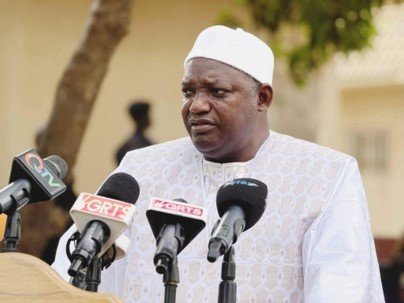
President Adama Barrow has defended his administration’s record on infrastructure development, particularly in the electricity sector, stressing that governing a nation is “not an easy task.”
Speaking during a political meeting at State House, Barrow highlighted what he described as significant progress in the country’s power infrastructure since he assumed office. He noted that The Gambia had long relied on ageing transmission systems that were inadequate to meet growing demand, but said his government has invested in major upgrades.
Among the improvements, Barrow cited the expansion of the transmission network from 33 kilovolts to 225 kilovolts, a development he said has strengthened the country’s ability to transmit electricity over longer distances and connect with neighbouring states. He added that new transmission lines have been introduced to provide backup capacity, ensuring supply can be maintained even when one line experiences a fault.
Reflecting on the state of electricity access during his youth, Barrow recalled the situation in Basse in 1976, when temporary arrangements were needed to provide power for public programmes. He contrasted that with current efforts to expand access nationwide.
The President also revealed that discussions are underway with Côte d’Ivoire to secure additional energy arrangements, with negotiations expected to conclude by October.
Despite these claims of progress, concerns remain among consumers and businesses over the reliability of electricity supply. Frequent disruptions continue to affect households and economic activity, raising questions about whether infrastructure investments are translating into dependable service.
Barrow’s remarks underscore the tension between his administration’s stated achievements in infrastructure and the ongoing challenge of delivering stable electricity to the Gambian population