The Ministry of Lands, Local Government and Religious Affairs has provided an update on the implementation of The Gambia’s National Land Policy, highlighting significant progress in ongoing reforms aimed at modernising land administration, reducing land disputes and improving access to land ownership documentation.
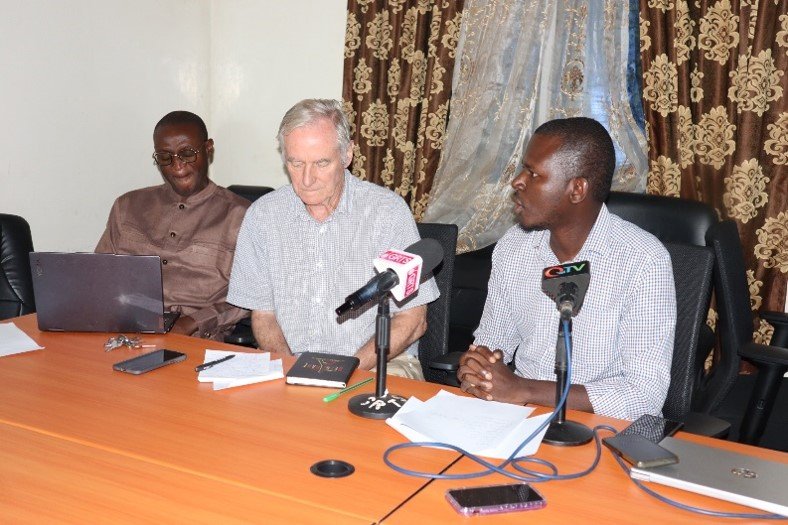
Speaking at a press briefing, the Head of the Land Policy Implementation Unit, Dr. Samba Sowe, disclosed that major milestones have been achieved since the policy was launched by President Adama Barrow in December 2025 and implementation commenced in January 2026.
Dr. Sowe said both the National Land Policy Steering Committee and the Land Policy Implementation Unit are now fully operational and actively overseeing the implementation process.
A key achievement, he noted, is the development of a National Land Information System (LIS). According to him, the alpha version of the digital platform has been completed and is currently undergoing testing to identify and address any technical shortcomings before its full rollout.
As part of efforts to modernise land records management, the ministry has also begun preparations for the digitisation of land records through the GIRAV Project. A specialised company has been contracted to establish a data conversion centre that will scan and convert historical land records, leases and related documents into digital formats for integration into the new system.
Dr. Sowe further revealed that the Physical Planning and Development Control Act has been reviewed and validated and is awaiting further government approval before submission to Cabinet.
He added that broader legal reforms are underway to address outdated land laws, some of which date back to the colonial era.
“Some of these laws date as far back as 1881 and have never been amended,” he said.
The government plans to consolidate several existing laws relating to state lands, land acquisition, compensation and land administration into a single Consolidated National Lands Act. An implementation roadmap for the consolidation process has already been validated.
The ministry has also completed and validated a National Resettlement Policy aimed at addressing challenges associated with development projects that require the relocation of affected communities. The policy is currently being prepared for Cabinet consideration.
To strengthen human resource capacity in the sector, the government has sponsored 20 Gambians through the GIRAV Project. Five beneficiaries are pursuing bachelor’s degrees in surveying, while 15 others are undertaking master’s programmes in areas including Geographic Information Systems (GIS), remote sensing, land valuation, land administration, land governance and policy.
Dr. Sowe said the graduates are expected to play a critical role in advancing the country’s land reform agenda upon completion of their studies.
One of the flagship initiatives under the policy is a pilot programme on Systematic Land Rights Registration (SLRR), which aims to issue Certificates of Customary Ownership to landholders. The pilot phase is scheduled to commence in Kombo East District in January 2027.
The certificates, he explained, will strengthen land tenure security and enable landowners to use their property rights as collateral to access credit and other financial services. Officials hope the initiative will significantly reduce processing times for land documentation, with a target of issuing documents within two to three days.
To improve access to land services, the ministry is also constructing fully equipped regional offices across the country with support from the GIRAV Project. The facilities are expected to be completed by May 2027.
According to Dr. Sowe, the regional offices will enable citizens to access land administration services closer to their communities, reducing the cost and inconvenience of travelling to Banjul or the Greater Banjul Area.
The ministry also plans to launch a nationwide public awareness campaign to educate citizens on the National Land Policy and its benefits. As part of this effort, the policy will be translated into local languages and disseminated through radio, television and print media.
Dr. Sowe emphasised the important role of private media organisations in promoting public understanding of the reforms and encouraging citizen participation.
Also speaking at the briefing, Gavin Adlington, Senior International Land Administration Specialist, underscored the importance of secure land rights in fostering economic growth.
Drawing on international experience, including examples from Kyrgyzstan, Adlington noted that effective land registration systems can expand access to credit, encourage investment and contribute significantly to national economic development.
He said secure property ownership allows citizens to leverage their assets for business expansion, housing development and other productive investments.
The ministry is additionally reviewing the country’s geodetic reference points established with support from the Japan International Cooperation Agency (JICA) between 2001 and 2003. Officials say some of the reference points may no longer be functional, prompting discussions on the introduction of modern Continuously Operating Reference Stations (CORS) to improve positioning accuracy and minimise boundary disputes.
Officials expressed confidence that the reforms will transform land administration in The Gambia by improving efficiency, enhancing transparency, reducing land disputes and creating greater economic opportunities for citizens.
The ministry pledged to continue providing regular updates as implementation of the National Land Policy progresses.