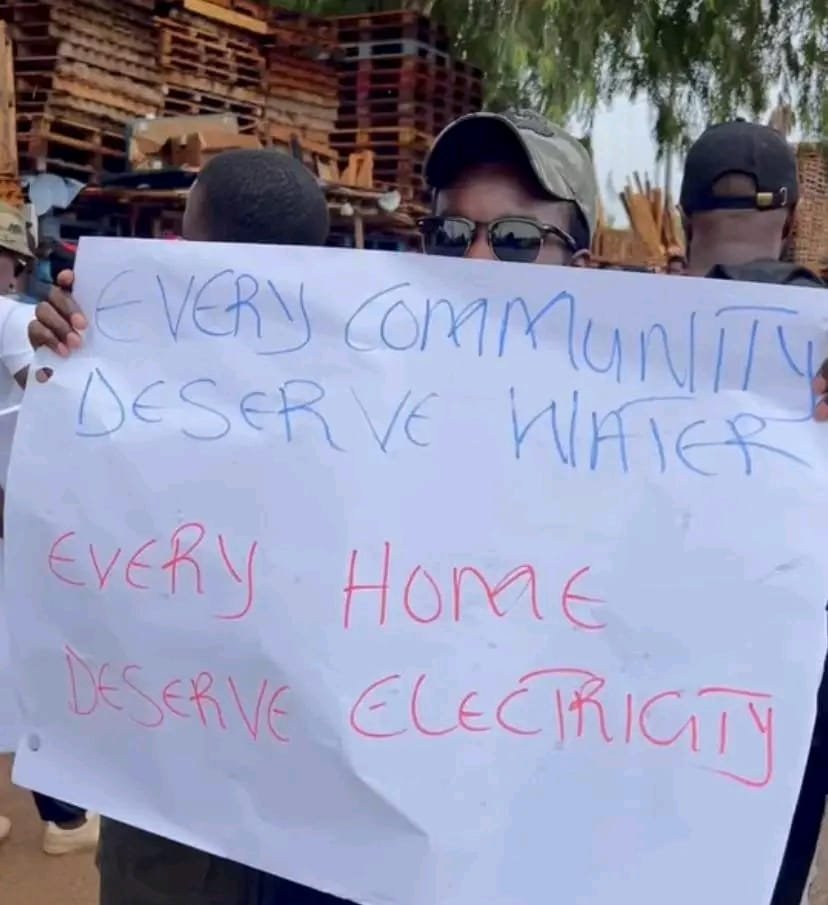
Residents and business owners’ outcry over darkness, losses, and lack of explanation
from the National Water and Electricity Company (NAWEC) over blackouts.
For the residents of Gunjur, the lights went out four days ago—and with them, any
semblance of normal life. As the silence of dead refrigerators fills homes and the stench
of spoiled food hangs in the air, a familiar dread is settling across the nation. Are we
heading back to the nightmare of May and June?
The current crisis is not just an inconvenience; it is a direct assault on the livelihoods
and dignity of Gambians. In Gunjur, families watch helplessly as their food stocks rot,
representing significant financial losses that many households and small businesses
can ill afford.
“This prolonged outage is having a serious impact on households, businesses, food
preservation and daily life in Gunjur. NAWEC, please hear the concerns of Gunjur
residents and restore electricity as soon as possible,” residents of Gunjur appealed
collectively.
As one resident poignantly put it, the explanations from the authorities “don’t cool a
fridge or fill a bucket.” Abdoulie T Taal expressed the nation’s frustration, stating: “Sixty
years after independence, NAWEC is still giving citizens a timetable telling us when we
will have electricity and when it will be cut off. According to their own schedule, this
nightmare will continue until the 30th. On the 19th, come out and demand what is
rightfully yours. We are not asking for favours. We are demanding accountability, dignity,
and the basic services every citizen deserves.”
This pain is echoed across the country. From the beaches of Tanji, where fishermen and
traders watch their perishable goods spoil, to the hospitals where patients reportedly
had to sleep outside for ventilation due to lack of power—the story is the same.
“This situation is seriously affecting people’s lives and businesses. We have received
reports from residents who went to the hospital seeking treatment, only to find that there
was no electricity. Some patients reportedly had to sleep outside simply to get proper
ventilation. How is this acceptable? Our small businesses are suffering. At places like
Tanji Beach, people invest huge amounts of money in fish, vegetables, and other
perishable goods. When the electricity goes off for hours, these products can spoil,
causing people to lose money they can barely afford to lose in this difficult economy,”
lamented Isatou Jobe.
However, the most galling aspect for many is NAWEC’s silence. While the company has
cited “extensive maintenance works on ageing generators” and delays in spare parts as
reasons for the outages, this explanation rings hollow for citizens who have paid their
bills and taxes only to be left in the dark without warning.
“NAWEC needs to be forthright, transparent and honest with the public. If there is a
problem with generation, fuel supply, transmission, distribution, maintenance or power
imports, tell the people exactly what is happening. Gambians can handle the truth. What
people cannot continue to tolerate is un” Certainty, conflicting explanations and
communication that leaves customers guessing about what is really happening,” said
Abdul Malick.
Meanwhile, Jankey Touray added a scathing critique of the government’s responses:
“Having to hear the government defend NAWEC’s brutality and calling citizens’
expression as ‘Manufactured outrage’ is the height of insults we can continue to take.
Within a space of a week, two people in the same neighbourhood of LK German were
severely assaulted due to power cuts. Are other residents better than those of German?
We demand an explanation from NAWEC and bring out the timetable that will show you
are truly prioritising hospitals and giving equal rights to all residents.”
In the same vein, the current blackout is a symptom of a much deeper, systemic failure
that has been decades in the making. Former NAWEC Director Alpha Robinson recently
pointed to a combination of crippling debt, neglected maintenance, and over-reliance on
imported fuel as the root causes of the crisis.
“NAWEC… AGAIN. The cycle continues: blackouts, low water pressure, high bills, and
apologies. What is the problem? Ageing infrastructure, rising fuel costs, revenue losses,
and growing demand are pushing the system to the breaking point. A system that
Gambians depend on every single day,” observed Hon. Abdoulie Bah, NAM for Banjul
North. “None of that is an excuse. It’s an explanation. And explanations don’t cool a
fridge or fill a bucket. The hardest hit are our clinics, schools, businesses, and homes.”
Despite billions of dalasis pumped into the energy sector over the last
decade—including massive projects funded by the World Bank and African
Development Bank—reliable electricity remains elusive. The OMVG regional network,
meant to be a saviour, has itself been plagued by technical issues and fuel shortages,
leaving The Gambia, which relies on imports, in a precarious position. The country is
now operating on barely half of what it needs to keep the economy running.
The erratic power supply has pushed citizens to their breaking point. Jankey Touray
captured the absurdity of the situation: “If NAWEC can take the electricity from the
residence of Latrikunda German, Gambia, for 4 to 5 days and bring it back at exactly
10:11 am today, to take it at 12:03, then I ask, what was the essence of bringing it?”
Hawa Njie connected the crisis to broader governance failures: “We are suffering a lot
and the saddest thing is their only focus is how to win the election. Now who benefits
from the so-called government? We the civilians who stand under the sun to cast a vote
or them who sit under the AC with everything covered with their family.”
Another resident, Mariama Sarr, delivered a devastating indictment of the current state
of the nation: “For months now, power is not stable and NAWEC leadership is still
comfortable. Hospitals are empty no medicine for ordinary people. The cost of living
keeps climbing, and life is harder than ever. Farmers are losing their farms and crops at
border areas. That’s something we’ve never seen before. We see corruption in almost
every government department. Public money is spent on 50-car convoys while citizens
are struggling. Innocent people trying to feed their families are being killed, some cases
end with no justice, and some suspects are even released. National problems are often
overlooked, yet all we hear about is partisan politics. And worst of all, some people now
reduce everything to tribe as if one group owns The Gambia. The Gambia is bigger than
tribe. Bigger than party. We asked for change so we could see progress, justice, and
unity. Be honest with me: Are we getting the change we fought for?”
This is not just about broken generators; it is about a broken social contract. As the
cost of living soars and the economy struggles, Gambians are tired of apologies. They
are demanding action:
Hon. Abdoulie Bah outlined a clear path forward: “What must happen now: 1.
Transparency: Monthly public reports from NAWEC on performance and outages. 2.
Proactive Maintenance: Fix systems before they fail, not after. 3. Investment: Scale up
renewables and efficiency to take pressure off the grid. 4. Accountability: Audit losses
and improve service delivery. Energy and water are not luxuries. They are the
foundation of health, jobs, and education. To NAWEC: We acknowledge the efforts of
your staff. But the people need results. Do better. To Government: Treat energy and
water as a national emergency and a national priority. To Waa Banjul North and beyond:
I hear you. I feel it with you. I will keep pushing in Parliament and in committee until we
secure light, water, and dignity for every household. We cannot keep having this same
conversation.”
“We are not asking for favours,” echoed residents from Gunjur. “We are demanding
accountability, dignity, and the basic services every citizen deserves.”
The government has called on citizens to be patient, but after 60 years of
independence, patience has run out. The Gambia deserves a dependable electricity
system to power its future. NAWEC must act now to end the suffering—and restore the trust of the people