Beyond the Notes from Santa Marta
Oilwatch statement on the Fossil Fuels Phase-out Conference
For thirty years, Oilwatch International and its affiliates have demanded that fossil fuels be left in the ground. This has been projected as the sensible thing to do if the world is to avert future deterioration of the climate crisis propelled by the extraction and consumption of fossil fuels. It was on this premise that the Fossil Fuels conference in Santa Marta would finally do what 30 sessions of the UNFCCC COPs had only tangentially addressed.
In this context, we acknowledge the success of the Conference for Territories Free of Fossil Fuels on April 24 and 25, which witnessed real exchanges of wisdom and practical strategies that are being implemented by the people to leave fossil fuels underground and develop alternatives to the current energy systems.
The official Conference also launched a Science Panel for the Global Energy Transition (SPGET) to support countries in overcoming dependence on fossil fuels by helping them develop roadmaps aligned with the 1.5°C trajectory. The risk here is that the wisdom, knowledge and political agency of the peoples who know which paths to take may be disregarded. Such a scenario may give rise to a rebirth of colonial impositions that subvert the interests of people and planet.
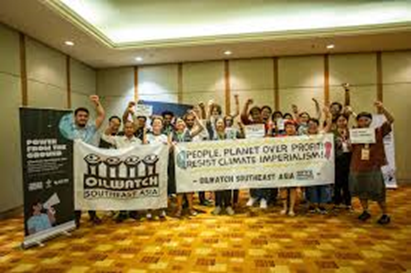
The process to achieve a truly just transition must be led by people in the territories, not politicians, corporations or co-opted academics.
Noting the unholy wedlock between the fossil fuels, military industrial machineries, warfare, and conflicts, the futures we need must endure restorative justice with checks to prevent the resurgence of violence. This violent energy source continues to feed the greed of politicians and corporations, generating wars and must be stopped.
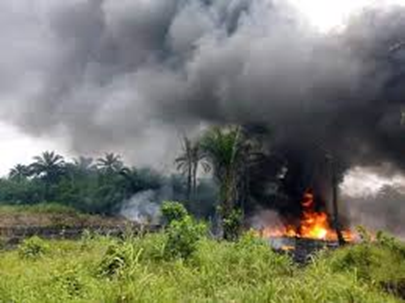
Oilwatch demands a permanent ceasefire and halt to the permanent environmental genocide in communities and territories where fossil fuels are extracted. Fossil fuels extraction in the Global South is an open warfare against the people and the planet. The environmental genocide inflicted on territories, communities and nations by fossil fuels extraction must be halted. This must be followed by clean-ups, remediation, dismantling, restoration and reparation. All fossil fuel time bombs must be decommissioned and dismantled. Now is the time.
The official Conference was to create exchange of wisdom, struggle, and strategy, a people’s gathering of frontline communities, indigenous nations, social movements, and grassroots organisations sharing concrete, community-led approaches to keeping fossil fuels in the ground and building post-extractive futures, all the weeklong meetings in Santa Marta could only deliver is a pouch of meeting notes that could easily have been compiled by an AI bot. To be fair, the note-takers state that the actual outcome of the conference will be made public in the future, probably during the climate weeks in London and New York later in the year. They characterise the conference as a safe space for conversations on fossil fuels phase down- an ignominious terminology crafted to avoid phasing out of fossil fuels. The conference also aligns with the processes of the UNFCCC, including the Paris Agreement and its package of NDCs, which have done little or nothing to confront global warming.
Oilwatch notes that the Santa Marta conference skirted the critical need to end dependence on fossil fuels and instead projected a process with no aim of achieving urgent, actionable outcomes. It was a conference of convenience hinged on trade and market environmentalism.
While the conference offered a safe space, the plight of indigenous groups, communities and territories turned into sacrifice zones with relentless ecocide was not as much noted in the notes. This blindsiding of the atrocious acts of colonial extractivism has glued the climate discourse to carbon molecules in the atmosphere while communities, territories and nations are mired by oil spills, gas flares, ecosystem decimation and related climate impacts and socioecological devastations.

Oilwatch notes the roadblocks erected by the Colombian government’s visa regime that kept grassroots and impacted groups from Africa, Asia, and elsewhere from being present and heard. An alleged “safe space” that is inaccessible to the most affected communities is not a safe space. It is an exclusion zone dressed in progressive language.
It is regretted that the voices of the victims of fossil fuels-driven extractivism were silenced, thus damping the importance of community-led resistance and the clear rejection of false climate solutions and market environmentalism offered as climate finance. The intersectional nature of climate justice pursuits and the projection of post-extractive futures and restorative justice, which goes beyond reparations to prevent future violence, remains muted.
Oilwatch saw the Santa Marta conference as a clear affirmation that the logic of our call for fossil fuels to be left in the ground is unassailable. Now is the time to centre the drive for post- fossil futures on the notable achievements of Ecuadorians rejecting oil extraction in Yasuni Ishpingo-Tambococha-Tiputini (ITT) and the people of Ogoni in Nigeria refusing a resumption of oil extraction in their territories since they peacefully forced a cessation of such activities in 1993. Similar struggles, such as those at Standing Rock in the USA, show the global momentum of this movement. Oilwatch believes it is time to “Yasunize” and “Ogonize” the world.
For years, Oilwatch has advanced the idea of Annex Zero, a position no government conference has yet formally adopted. Annex Zero calls for certain territories, ecosystems, and communities to be permanently declared off‑limits to fossil fuel extraction. This means no phase‑down timelines, no transitional licenses, and no negotiations. Simply put: total zero extraction.
Oilwatch also reiterates that urgent phasing out of fossil fuels and real climate action must be anchored on the Common But Differentiated Responsibilities (CBDR) principle, which is the key justice pillar of the UNFCCC. In this light, nations must be required to cut emissions at source at legally binding levels. The Annex Zero principle proposed by Oilwatch must also be taken on board. This principle requires that nations that keep fossil fuels in the ground be recognised as climate champions and duly compensated for helping to avoid catastrophic climate change.
The polite Santa Marta conversations emphasised financial mechanisms, benefit sharing, and other pathways constructed on the imaginary that has kicked the climate conference down the unending conferences avenue for years. It is time to recognise the intersectional nature of the climate crisis and the essential need to bring all impacted parties into the room.
For 30 years, Oilwatch International has consistently called for fossils to be left in the ground and demanded the recognition and payment of climate/ecological debt. We stay on this path with the confidence that the futures of our dreams are attainable. It is time for a phase-out, not a phase-down of fossil fuels. That will be the real, just, and equitable transition.
Santa Marta was a great but missed opportunity.