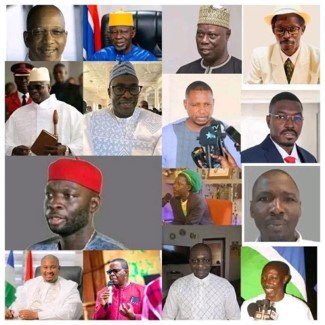
The coming presidential election presents The Gambia with a fundamental choice: continue to depend heavily on imported goods, external financing and a narrow economic base, or build a productive economy that creates jobs, strengthens food security and gives its young people a meaningful stake in the nation’s future.
The economic facts point to a country with genuine potential, but also deep structural weaknesses. Economic growth is occurring, yet growth alone does not guarantee affordable living, productive employment or economic independence. The critical question is whether national wealth is translating into better opportunities for ordinary Gambians.
1. The economy: Growth, but not yet enough transformation
According to the International Monetary Fund, The Gambia’s economy grew by an estimated 6% in 2025, following growth of 5.6% in 2024. Growth has been supported by agriculture, construction and tourism. Average consumer-price inflation fell from 11.6% in 2024 to an estimated 7.9% in 2025.
These are encouraging developments, but inflation remains above the Central Bank’s medium-term target of 5%.
The less comfortable facts are equally important. Public debt remains high, government finances face considerable pressure, and the country remains vulnerable to international food and fuel prices, currency movements and disruptions to imported supplies.
Tourism, agriculture and construction contribute to growth, but The Gambia still needs a much stronger base of competitive domestic manufacturing and value-added agricultural industries.
The distinction is crucial: a country can record respectable GDP growth while many households continue to struggle with the cost of living and young people struggle to find decent work.
The next government must therefore be judged not simply by how fast the economy grows, but by how many productive jobs it creates, how much food it produces, how much it manufactures and how much foreign exchange it saves or earns.
2. The import bill: Money leaving that could build Gambian businesses
The Gambia imports food and other essential commodities that, in whole or in part, could be produced, processed or packaged locally.
World Bank WITS trade data for 2024 provides some striking examples:
Rice: Approximately US$70.16 million in imports.
Wheat: Approximately US$29.52 million in imports.
Onions and shallots: Approximately US$4.11 million in imports.
Vegetable oils: Approximately US$20.80 million in one reported import category.
Together, these four categories account for approximately US$124.6 million in imports in 2024. This is an illustration of the opportunity, not the country’s total food import bill.
Rice imports could be reduced through improved irrigation, better seeds, mechanisation, milling and storage. Wheat is more difficult to replace fully, but locally grown millet, maize and other suitable grains could be developed for selected food products and animal feed.
Similarly, improved horticultural production and storage could help Gambian farmers capture a greater share of the onion market. Local oilseed cultivation, crushing and refining could replace some imported vegetable oils, provided production costs and yields are competitive.
The comparison with local production is revealing. The Gambia has farmers, cultivable land, water resources in suitable areas, fisheries, livestock and an entrepreneurial population. Yet these resources do not automatically translate into reliable commercial supply.
Farmers need affordable inputs, irrigation, machinery, financing, guaranteed buyers and storage facilities. Processors need reliable electricity, food-safety standards, packaging and transport. Retailers and public institutions need dependable supplies at competitive prices.
The national objective should be to measure, commodity by commodity, how much is imported, how much is produced locally, how much local production costs and what realistic share of imports can be replaced over five years.
Every dollar of imports that can be competitively replaced by a Gambian product is an opportunity to support local incomes, create jobs and reduce pressure on foreign exchange.
3. Electricity: The missing foundation of industrial development
No country can build a substantial manufacturing sector without reliable and affordable electricity.
The Gambia has made progress in expanding electricity infrastructure, but generation capacity and reliability remain important constraints. A World Bank document reported total installed capacity of 158 MW in 2024, with only around 102 MW available at the time because of ageing generating equipment.
The country also relies on imported electricity and independent power producers alongside domestic generation.
The consequences extend far beyond household inconvenience.
A rice mill cannot operate competitively if electricity is unreliable or too expensive. A cold-storage facility cannot protect fish, meat, fruit and vegetables without dependable power. A factory producing cooking oil, animal feed, dairy products or packaged foods needs predictable operating hours and costs.
Small businesses lose income when production stops, while backup generators increase operating expenses. Investors are less likely to establish energy-intensive businesses where power supply is uncertain.
The result is a vicious cycle: weak industrial activity limits job creation and tax revenue, while an inadequate and costly power system makes industrial investment less attractive.
Breaking that cycle requires a practical energy strategy. The country should expand and rehabilitate generation, improve transmission and distribution, diversify into solar and other appropriate energy sources, and make strategic use of regional electricity interconnections. Power purchase agreements must be evaluated for affordability, reliability and long-term value for money.
Hydropower imports and regional electricity trade can contribute to the solution, but they should complement a coherent national energy plan rather than substitute for it.
Most importantly, electricity planning must be linked directly to industrial development. Government should identify the sectors with the strongest employment and export potential, estimate their power requirements, and ensure that industrial zones and productive rural areas receive reliable supplies.
The benefits would be substantial: new factories, reduced post-harvest losses, more competitive businesses, skilled jobs, increased tax revenues and potentially greater exports.
Electricity is not simply another public service. It is productive infrastructure.
4. The youth: The Gambia’s greatest economic asset
The Gambia’s population is exceptionally young. The 2024 Population and Housing Census preliminary report recorded approximately 2.4 million people, of whom 40.8% were under 15 years of age.
That means roughly two in every five Gambians were children alone, before counting young people aged 15 and above.
For the economy, this creates both an urgent responsibility and an extraordinary opportunity.
Young Gambians face a range of challenges: insufficient formal employment, limited access to affordable finance, skills that do not always match labour-market needs, weak opportunities to acquire work experience, and barriers to land, equipment and markets. The risks of irregular migration and the loss of skilled young people are also part of the national debate.
The World Bank’s ILO-modelled estimate for unemployment among people aged 15–24 was 10.9% in 2025. That figure does not capture every young person who is underemployed, discouraged from seeking work or earning too little in informal employment.
Yet young Gambians possess enormous strengths: energy, creativity, adaptability, digital familiarity, entrepreneurial ambition and the ability to learn new skills. Many are already active in farming, trading, transport, technology, tourism, creative industries and small businesses.
The challenge is to turn that potential into productive economic participation.
What should investment in youth actually look like?
First, connect education to employment. Expand technical and vocational training in electrical installation, renewable energy, food processing, refrigeration, construction, manufacturing, mechanics, digital services and modern agriculture.
Second, make young people producers, not merely job seekers. Develop youth-led enterprises in rice cultivation, horticulture, poultry, fisheries, livestock, honey, food preservation, packaging and local manufacturing.
Third, provide access to finance and markets. Establish transparent, properly supervised financing facilities, business incubation, equipment-leasing schemes, apprenticeship opportunities and procurement arrangements that help viable young businesses secure customers.
Fourth, create work through national priorities. Infrastructure, electricity, agriculture, housing, tourism and digital transformation should all include measurable local employment and skills-development targets.
Fifth, invest in young women as well as young men. Access to training, land, finance, technology and business opportunities must not be determined by gender or family connections.
The returns would extend beyond employment. Productive young people earn incomes, support families, pay taxes, create further jobs and reduce the pressure on public welfare systems. Successful youth enterprises can also help reduce import dependence and build export industries.
Investing in the youth is not charity. It is economic policy, social protection and national development combined.
5. Are political parties offering realistic plans for youth investment?
There are political platforms that address important parts of this agenda. However, a manifesto’s existence does not prove that its promises are financially realistic or that they will be delivered.
Two published platforms are particularly relevant.
Gambia For All (GFA)
GFA launched its manifesto in August 2026, organised around food security, economic transformation, human-capital development and government reform. Those priorities directly address several of the country’s structural economic problems, including the need to create opportunities and develop a more self-reliant economy.
Unite Movement for Change
Its published policy platform proposes increasing technical and vocational education enrolment by 40%, aligning education with labour-market needs, restructuring the electricity sector, promoting local industry and strengthening local participation in public procurement.
These are specific policy directions that can be assessed against national needs.
These are meaningful policy commitments, but it would be premature to declare either party’s entire economic programme fully realistic without independently examining its costings, funding sources, implementation capacity and measurable employment targets.
Gambians should ask every presidential candidate the same questions:
How many new jobs will be created each year, and how many will be formal, productive jobs?
What is the specific plan for affordable, reliable electricity for businesses and factories?
What percentage of selected food imports can realistically be replaced within five years?
How will youth businesses obtain finance, equipment, land and customers?
What will each major proposal cost, where will the money come from, and who will be accountable for delivery?
What annual public reports will demonstrate progress or expose failure?
A credible manifesto should contain measurable targets, realistic timelines, credible financing and independent monitoring. Broad promises of empowerment are not enough.
6. The economic choice facing the next government
The Gambia does not lack potential. It needs to organise its resources around a productive national strategy.
A government serious about transformation would link agriculture to food processing, electricity to industrial investment, education to employment, and public procurement to competitive Gambian businesses. It would support local firms without protecting inefficient producers indefinitely, and it would judge policies by results rather than announcements.
The opportunity is to build a country where farmers supply processors, factories employ trained young people, reliable electricity keeps businesses running, and locally made products compete with imports on price and quality.
Such a strategy would not eliminate the need for imports, foreign investment or international partnerships. It would make the country better able to pay for what it cannot efficiently produce, while keeping more economic value at home.
Conclusion: The future must be built, not promised
The presidential election of 5 December 2026 should be about more than political personalities, party loyalty and campaign slogans. It should be a national debate about the economy Gambians want and the practical measures required to build it.
Growth without enough productive jobs is incomplete. Agriculture without processing leaves value unrealised. Electricity without industrial development misses a major opportunity. Education without routes into work frustrates young people and wastes national investment.
The next government must demonstrate how it will turn these interconnected challenges into a coherent programme of national development.
The Gambia’s greatest resource is not merely what lies beneath its soil, what passes through its ports or what visitors spend in its hotels. It is the ability of its people—especially its young people—to produce, innovate, build businesses and create value.
A country that invests in that ability can reduce its dependence, strengthen its economy and give its citizens a more secure future. The election offers an opportunity to demand precisely that: not another collection of promises, but a credible plan to make The Gambia a more productive, self-reliant and prosperous nation.