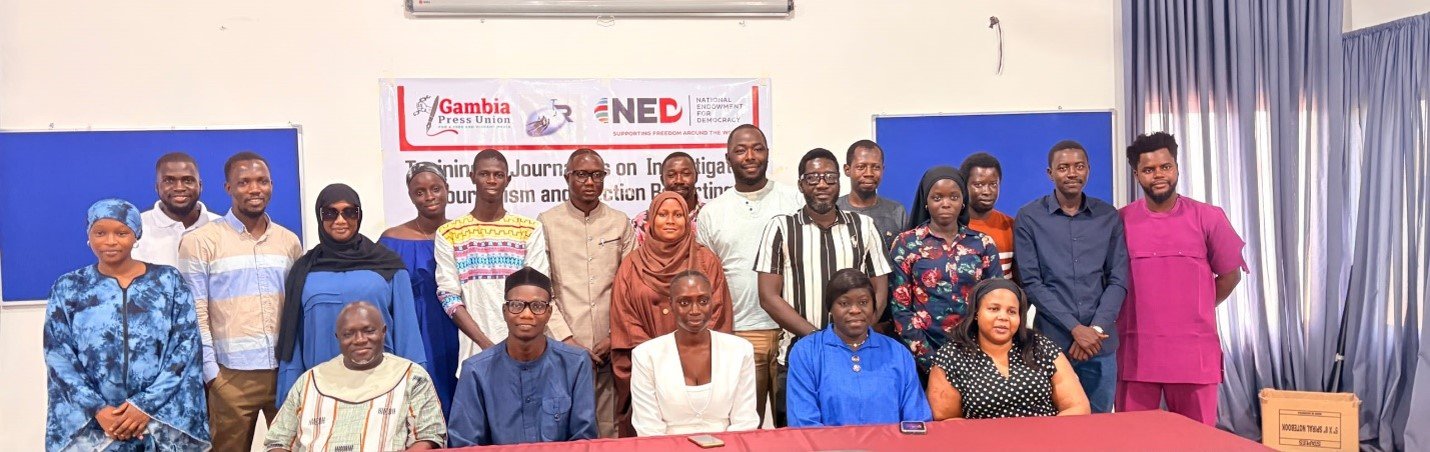
The Gambia Press Union (GPU) has launched a six-day capacity-building training on investigative journalism, election reporting, and fact-checking, aimed at strengthening the role of the media ahead of the 2026 Presidential and 2027 Parliamentary elections.
The training was held on Monday, at the National Nutrition Agency (NaNA). It is part of a newly approved project on “Strengthening Electoral Integrity and Accountability” funded by the National Endowment for Democracy (NED) and Implemented by the GPU and The Republic.
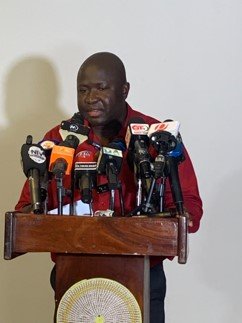
Speaking at the opening, GPU Vice President Sheriff Saidykhan described the initiative as “timely and significant,” noting that investigative journalism is essential in exposing corruption, countering misinformation, and empowering citizens with credible information.
“Journalists must prioritize accuracy over speed and provide evidence-based reporting. This training will enhance their ability to report ethically, identify hate speech, and promote conflict-sensitive coverage,” Saidykhan stated.
The program forms part of the DOCT project, which seeks to empower voters through transparency and accountability. Participants will gain practical skills in tracking public procurement, analyzing asset declarations, and investigating corruption, while also learning safety measures such as secure communication and source protection.
Delivering a keynote address, Madi Jobarteh, CEO of the Edward Francis Small Centre for Rights and Justice, warned that The Gambia’s democratic transition remains fragile.
“Democracy is not sustained by elections alone. It is strengthened when citizens have access to accurate, verifiable, and independent information,” Jobarteh said.
He highlighted challenges including a culture of impunity, weaknesses in public financial controls, and the growing digital battlefield where misinformation spreads rapidly during elections.
Jobarteh urged journalists to move beyond “reactive reporting” and instead investigate campaign financing, verify digital content, and expose corruption.
The initiative includes three interconnected trainings: Investigative journalism, equipping journalists to follow the money, track procurement, and analyze asset declarations.
Election reporting focusing on ethical, inclusive, and conflict-sensitive coverage across the electoral cycle.
Fact-checking, teaching verification of claims, authentication of digital content, and use of open-source intelligence.
Jobarteh described the participants as “the vanguard of a more informed and accountable Gambia,” stressing that their professionalism and integrity are vital to safeguarding democracy.
Both speakers emphasised that journalists have a constitutional duty to hold power to account. Jobarteh reminded participants:
“Freedom is not a privilege granted by those in power. It is a right enshrined in our constitution. Your professionalism is your shield, and your integrity is your sword.”
The training, supported by the National Endowment for Democracy, will also produce a media handbook on audit reporting in collaboration with the National Audit Office.
As The Gambia prepares for its next electoral cycle, the GPU insists that a free, independent, and professional media is essential to transparency, accountability, and good governance.