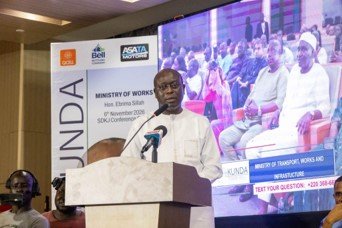
The Minister of Transport, Works and Infrastructure, Ebrima Sillah, says the government has constructed approximately 1,200 kilometres of roads since 2017 as part of efforts to address The Gambia’s estimated 4,000km road infrastructure deficit.
Speaking at the Mansa Kunda Ministerial Town Hall Meeting, Sillah disclosed that another 1,600 kilometres of roads are currently being surveyed nationwide to determine the scope of work required.
He said the road deficit continues to grow partly because new residential estates are developed without adequate road networks, leaving the government to provide access roads as settlements expand.
The minister also disclosed that the World Bank has initiated engagements to conduct studies on an additional 500 kilometres of roads, separate from the government’s ongoing survey. He said the Bank is considering financing 150 kilometres, while discussions are ongoing with other development partners to mobilise funding for the remaining 350 kilometres.
On bridge infrastructure, Sillah cited the OIC and Sukuta-Jabang overpasses as projects that have improved traffic movement and reduced reliance on traffic lights at the respective junctions. He said the Sukuta-Jabang bridge is expected to be officially inaugurated by President Adama Barrow soon.
He added that traffic lights would still be installed at strategic locations where necessary, while stressing the need for regular maintenance of existing bridges to ensure their safety and durability.
Addressing concerns about delays in road construction following the demolition of properties, Sillah attributed some of the challenges to ownership disputes, compensation procedures and the technical requirements involved in clearing construction sites.
He explained that some affected properties are occupied by relatives of registered owners who may not be present during the compensation process. In such cases, families are required to obtain a power of attorney before compensation can be processed.
According to the minister, compensation is paid through the formal government banking system, but disagreements over who should receive the payments sometimes delay the process and require the involvement of the Ministry of Justice.
Sillah further explained that road construction does not necessarily begin immediately after demolitions, as the government must first clear the right of way and relocate utility infrastructure, including water pipes and cables, before contractors can commence work.
He also appealed to motorists to give way to ambulances whenever they hear their sirens to facilitate emergency response. He said efforts are also being made to improve access for ambulances and buses at designated points.