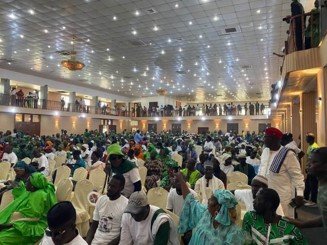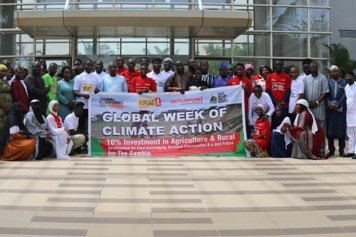
The Select Committee on Agriculture and Rural Development of the National Assembly on Friday joined civil society stakeholders in a breakfast meeting on the implementation of the Maputo Declaration on Agriculture and Food Security in Africa. The event, organised by ActionAid International the Gambia, was held at the National Assembly in Banjul.
The engagement provided a platform to assess The Gambia’s progress in meeting the continental commitment to allocate at least 10 per cent of national budgets to agriculture and rural development, while also addressing broader challenges of food security, agricultural financing and climate resilience.
In his welcoming remarks, Deputy Clerk for Legislative Business and Programmes, Daniel Cardos, emphasised the centrality of agriculture to rural livelihoods and national food security. He underscored the Committee’s oversight role in scrutinising budget estimates, engaging with the Ministry of Agriculture, and monitoring agricultural programmes. Cardos described the Committee as being “at the very heart” of ensuring that Maputo and Malabo commitments translate into tangible outcomes for farmers and communities.
Delivering the keynote address, Fafa O. Cham, Head of Programmes and Policy at ActionAid International the Gambia, highlighted the country’s reliance on imported food and its implications for household food security and economic resilience. He called for stronger investment in domestic production and local value chains, including support for farmers, inputs, irrigation, storage, processing and market access. Cham also stressed the vulnerability of The Gambia’s rain-fed agriculture to climate change, urging policymakers to integrate climate justice into national planning.
Committee Chairperson Hon. Omar Darboe reaffirmed that the 10 per cent Maputo benchmark should be seen not merely as a budgetary target but as a reflection of agriculture’s importance to national development. He noted that the 2026 National Budget allocates D7.10 billion to agriculture representing 11.97 per cent of total spending surpassing the Maputo threshold.
However, he cautioned that Parliament’s responsibility extends beyond figures, asking whether resources are reaching farmers and producing results in productivity, irrigation, mechanisation, extension services, storage, market access, livestock development, research, and climate resilience.
Darboe described the meeting as an opportunity to evaluate how budgetary commitments are being translated into practical interventions and measurable results for farmers, women and youth in agriculture, smallholder producers, livestock keepers, food processors and other actors across the agricultural value chain